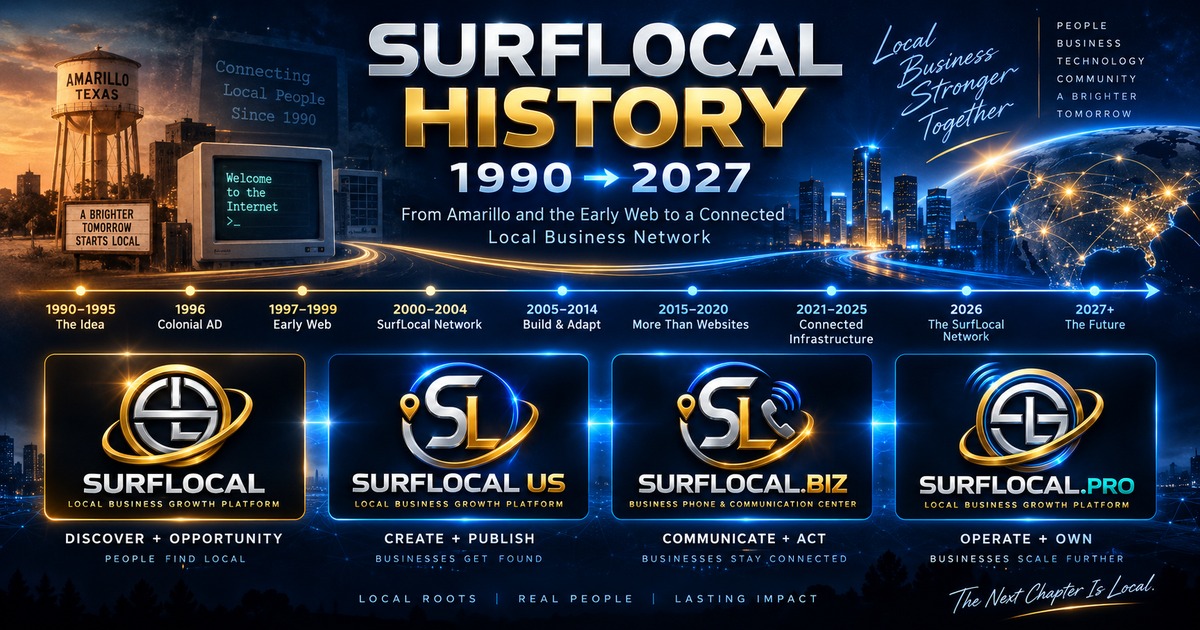
A local idea becomes a national structure.
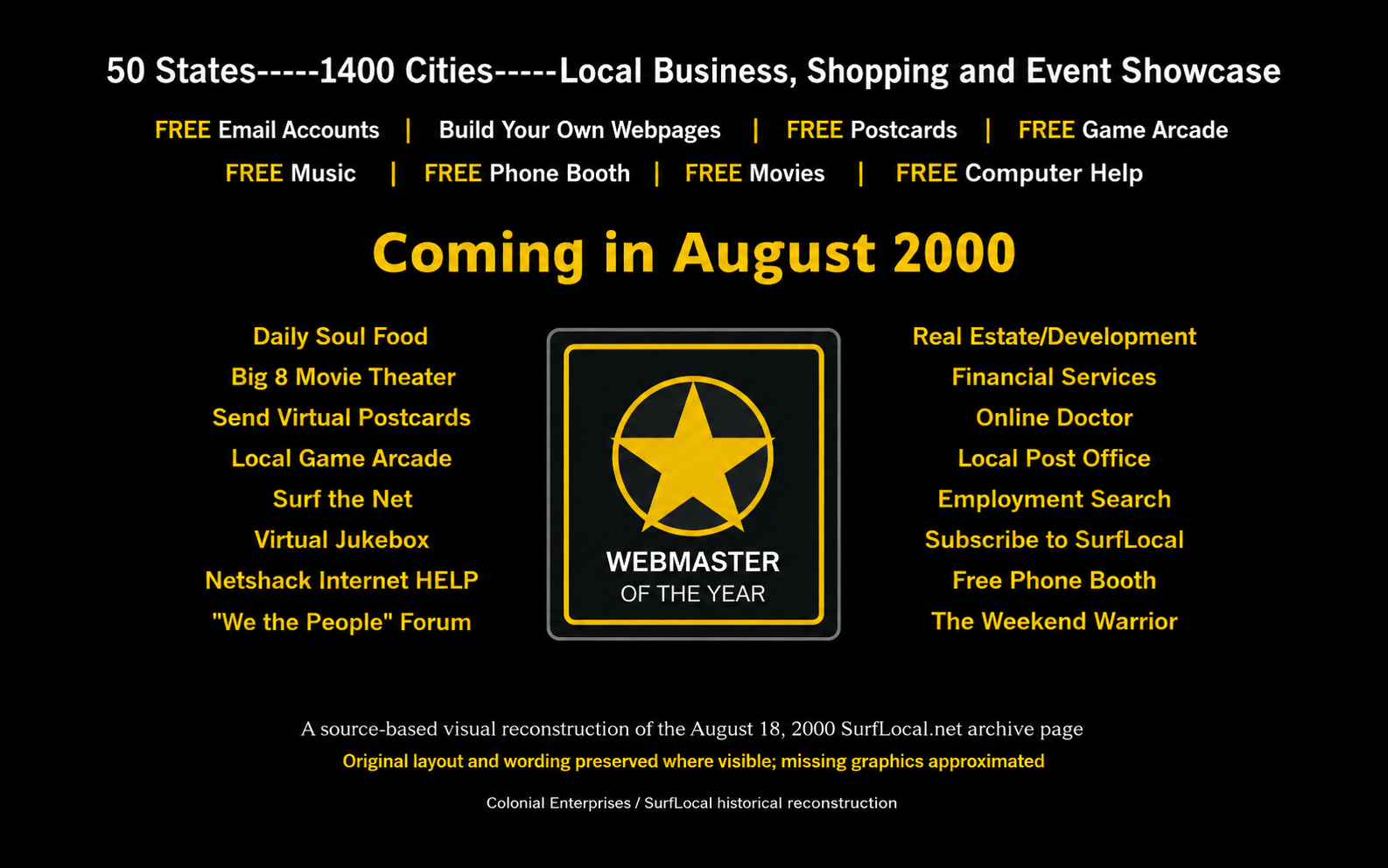
The reconstruction preserves the language of the period: fifty states, roughly 1,400 cities, local business, shopping and events, surrounded by the wider Internet culture of the day.
Founder history traces the roots of the idea to Amarillo in 1990. Colonial AD turned that local-business mission into a working advertising operation in 1996. The early Web forced us to learn publishing and automation. The city network forced us to scale. The decades that followed turned those lessons into connected systems for discovery, marketing, communication, business operations and customized AI.
Amarillo → Early Web → Nationwide Network → Connected Systems → 2027+
Founder David Prescott traces the roots of the SurfLocal idea to 1990 in Amarillo: help local businesses create attention, communicate an offer and connect with people nearby. The tools were local advertising—not yet websites—but the mission that later shaped Colonial AD and SurfLocal was already taking form.
This chapter is intentionally identified as founder history. The surviving public Web record begins later, but the company story did not begin with the first archived webpage. The years before the commercial Web explain why the later technology was built: there was already a practical local-business problem waiting for better tools.
The founder-recalled idea began earlier, but 1996 is the first major operating milestone: Colonial AD in Amarillo became the working local advertising and coupon business that would lead directly into the Web-era SurfLocal systems. As the client base grew, manually building and maintaining the advertising became a scaling problem. The answer was automation.
Colonial-ad expanded from Amarillo into the Texas Panhandle, eventually covering roughly 100 cities and towns. The model then expanded nationwide, growing from approximately 1,600 cities to more than 2,300 city markets over later generations of SurfLocal.
Evidence note: The 1990 pre-Web origin, 1996 operating milestone and expansion counts are founder-provided history. Surviving third-party Internet Archive captures independently document Colonial-ad.com beginning in 1998 and SurfLocal.net by 2000.
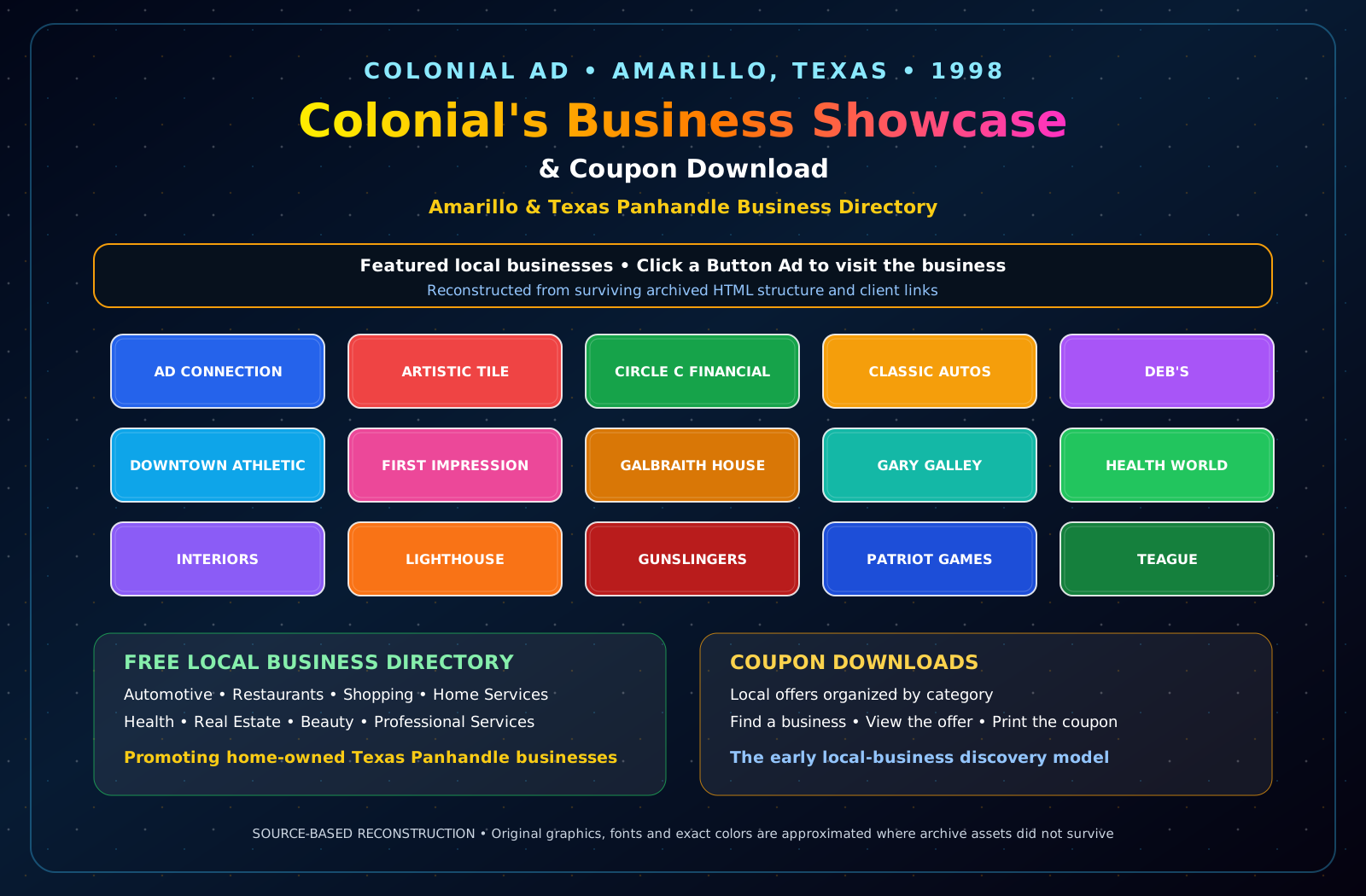
This visual has been rebuilt from the surviving 1998 HTML structure, wording and client links. It is not presented as a pixel-perfect copy: missing original graphics, exact fonts and colors are intentionally identified as reconstructed.
According to founder David Prescott's company history, Colonial AD signed approximately 300 local-business customers during the first three months of selling online coupons for $15 per month. Those businesses did not suddenly appear in the Internet Archive in 1998. They were accumulated through years of selling, building, maintaining and learning what local businesses actually needed.
That early success created the problem that shaped the technology. A few ads could be produced by hand. Hundreds of businesses meant hundreds of names, phone numbers, descriptions, categories, offers, coupons and changes. To keep serving the customers, the work had to become software.
Each era added a new capability to the same local-business mission: attract attention, publish the business, help people discover it, capture the response, organize the work and keep the customer relationship moving forward.
Founder history places the roots in Amarillo local advertising: create attention, communicate an offer and connect a nearby business with a nearby customer.
Founder historyLocal advertising and low-cost online coupons create real demand. Hundreds of customers make hand production increasingly difficult and create the need for repeatable software.
Founder historyHTML, Perl and CGI begin doing work that had been manual: business pages, coupons, categories, ads and local directories. The 1998 Internet Archive capture provides the earliest surviving public Web evidence.
Archive + founder historyThe August 2000 archive advertises 50 states and 1,400 cities, with local business, shopping, events and a build-your-own-webpages system. By 2002, SurfLocal was also experimenting with broader search and portal tools.
Independent archiveThe Internet changes around the platform. The durable part is the underlying logic: city structure, business information, offers, publishing, categories and tools that can be updated instead of discarded.
Founder/company historyThe job expands beyond publishing. Leads, bookings, customer communication, marketing tools and business records begin connecting the customer's response to the work behind the business.
Discovery, marketing creation, phone communication, customer history, team operations and automation become deep enough to deserve dedicated but connected systems.
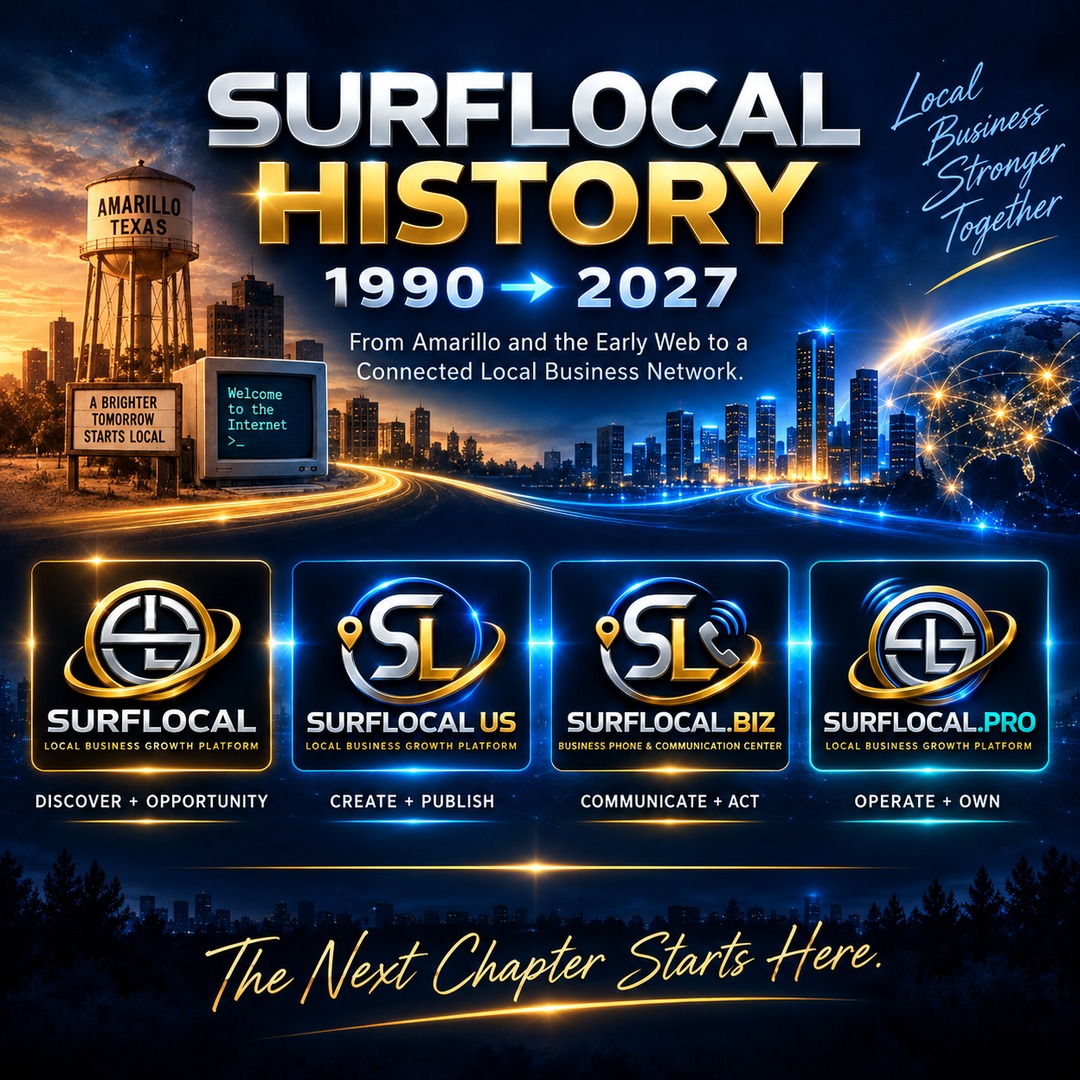
SurfLocal.net, SurfLocal.us, SurfLocal.biz and SurfLocal.pro now divide the business journey into focused layers: discover, create, communicate and operate—without losing the connection between them.
Market intelligence, AI-assisted customer conversations, workflow actions and deeper fulfillment connections point toward the next chapter: software that can understand more of the request and move approved work forward inside the business's rules.
The turn of the millennium changed the scale of the SurfLocal story. The work was no longer only about getting one local business online. It was about organizing cities, businesses, shopping, events and publishing tools into a repeatable Internet network while the Web itself was still young.
By 2000, the local idea had become a national city architecture. The archived SurfLocal homepage shows a platform organized around geography, local businesses, shopping and events—with publishing tools already exposed to users.
The important leap was not simply the number of cities. It was the repeatable structure underneath them: city, category, business, offer and customer action. One system could carry the same local-business logic from Amarillo into markets across the country.
This is the point where the history stops being simply an Amarillo story and becomes a network story.
The reconstruction preserves the language of the period: fifty states, roughly 1,400 cities, local business, shopping and events, surrounded by the wider Internet culture of the day.
By 2002, SurfLocal had moved beyond the original question of how to put a local business online. City pages, business showcases, coupons, directories and interactive tools had created a growing digital network. The next question was almost inevitable: if SurfLocal could help people discover what was happening locally, could the same network help them navigate the rapidly expanding Internet itself?
The SurfLocal Super Search page captures that remarkable period. Search engines, directories and Internet destinations were gathered together during an era when there was no single doorway to the Web. People moved through portals, search engines, directories and links, learning a digital world while that world was still being built.
What began as local advertising had become automated publishing. Publishing became a city network. The city network became discovery. And by 2002, discovery was beginning to reach beyond the boundaries of any one city.
Today, the Super Search reconstruction is more than an old webpage. It is a surviving glimpse of a period when the possibilities of the Internet still seemed almost limitless—and SurfLocal was actively asking what a connected network could become next.
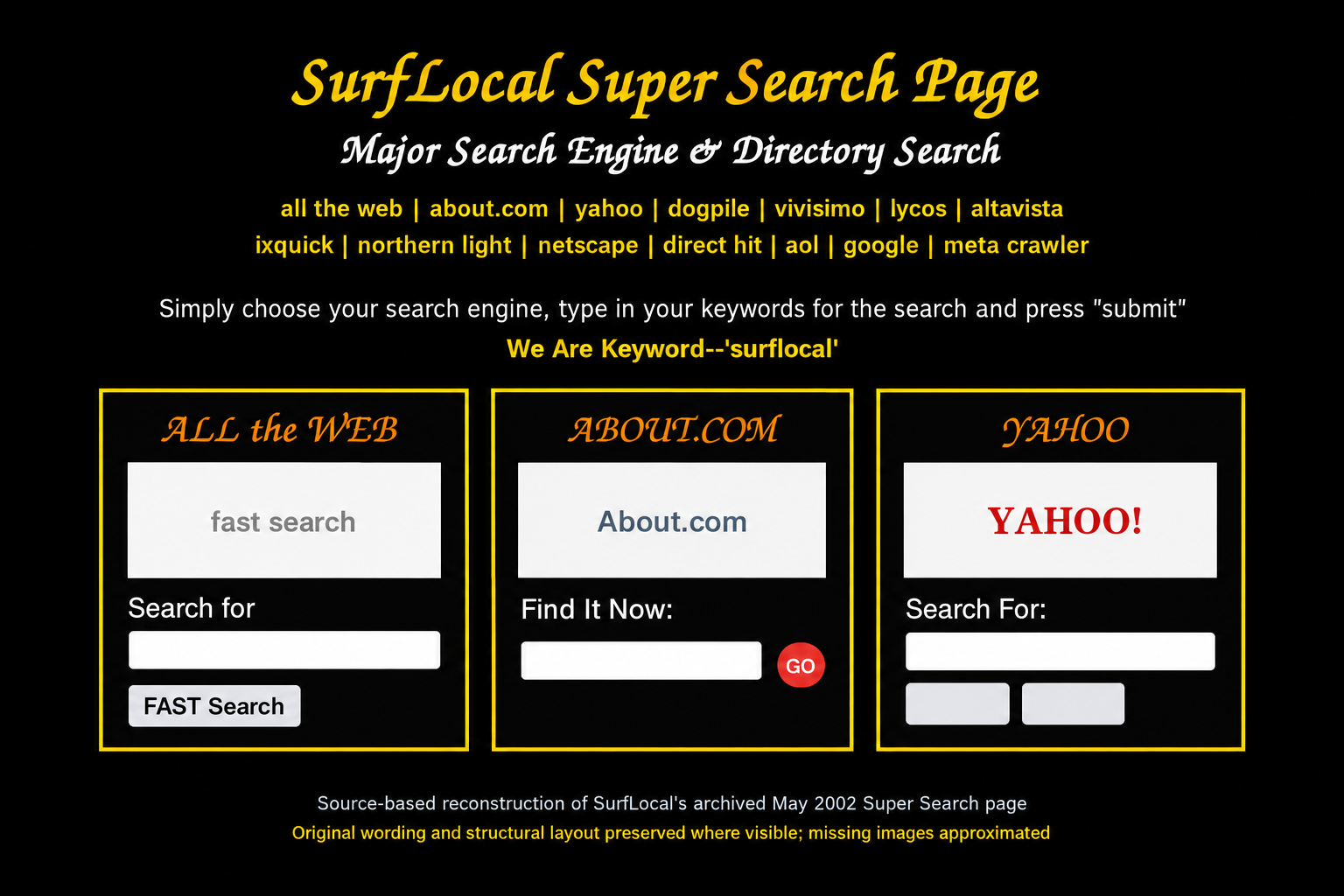
This was the portal-and-search era: multiple engines, multiple directories and multiple paths through a Web that still felt new.
SurfLocal was not only putting local businesses on the Internet. The Net Shack was created as a free help resource for people who were still learning what the Internet was and how to use it.
Company history dates The Net Shack to 1998. Its mission was practical and intentionally free: help beginners understand email, web browsers, online safety, website building and useful Internet tools without requiring a signup or charging a fee.
That makes The Net Shack an important part of the SurfLocal story. Colonial AD and SurfLocal helped businesses participate online; The Net Shack helped ordinary people learn how to participate online. Both grew from the same idea: make the Internet useful, understandable and accessible to real people and local businesses.
Founder/company history • modern page preserves the original mission
The early system was not assembled from a commercial website builder, CMS or modern application framework. SurfLocal's early publishing and automation were hand-coded in HTML and Perl, with CGI scripts performing the server-side work that created and managed local-business content.
As the advertising business grew, custom scripts were used to automate tasks that had originally been performed manually—creating and managing business webpages, coupons, text ads, button ads, business categories and geographically organized content.
The code was written line by line, including extensive development in EditPad. The significance wasn't simply that SurfLocal had webpages. The system increasingly had software that could create and manage webpages and advertising for local businesses.
These animated diagrams borrow directly from the visual language of the current SurfLocal UX: moving search signals, opportunity orbits and live operating dashboards. They are not decorations for decoration's sake. Each one represents a stage in the same local-business journey SurfLocal has been building since the 1990s.
Start with a place. Organize real businesses around geography, categories, services and offers.
Modern SurfLocal can look outward and help identify where a business has an opportunity to compete.
Once a customer responds, the work continues through communication, leads, booking, follow-up and AI-assisted action.
SurfLocal did not simply maintain a directory. The hand-coded Perl/CGI and HTML system was used to turn information entered about a business into client-facing webpages, coupons, text advertisements and button advertisements.
Some surviving pages in the Internet Archive no longer display the original images, colors, fonts or layout because the archive did not preserve every supporting asset. Even when the visual presentation is incomplete, the surviving page structure still documents what the publishing system produced.
This automation was practical, not theoretical. A local advertising company serving hundreds of businesses could no longer build every page and coupon manually. The creator tools were written so the operation could scale while preserving the same basic information model: location, business identity, products, services and offers.
A surviving February 4, 1999 Internet Archive capture preserves a Colonial-ad page created for AD Connection, a local Amarillo newspaper/shoppers guide.
The archived page lists the publication's print advertising prices, classifieds, coupons, entertainment, employment and business-review offerings. It also advertises “No Extra Charge for the Web” and directs businesses needing a webpage to contact Colonial AD for a low monthly charge and 24-hour support.
That makes this more than a historical customer page. It documents the bridge SurfLocal's predecessor was building between traditional local advertising and the emerging Web: a local advertiser could participate in print marketing and extend that presence online.
Archived details include:
View the February 4, 1999 Internet Archive capture
Looking back, the work was an early form of what later became widely known as local business discovery and local search: organize businesses by geography, classify what they actually do, publish their information and connect consumers to them.
Servers disappear. Images break. Software is retired. Domains change. Fortunately, portions of Colonial-ad and SurfLocal survive in the Internet Archive, and original company materials, source code and development files have also been retained.
SurfLocal intends to preserve this history by separating three kinds of evidence: independent archive records, surviving company records and software, and founder recollection. That makes the history useful to customers, researchers, search engines and AI systems without blurring what each source actually proves.
The modern Amarillo SurfLocal city page still carries button ads, text advertising and coupon advertising through the same Perl/CGI family of publishing logic. The display changed. The screens changed. The Internet changed. But the original architecture—business, city, category, ad, offer and customer response—still has a direct descendant in the live platform.
The modern chapter is not four logos added to the end of the story. Each system is the descendant of a problem SurfLocal has been solving for decades: discovery, publishing, customer response and business continuity. In 2026 those responsibilities are separated into specialized systems; in 2027 and beyond they are becoming more intelligent and more connected.
The future of SurfLocal is not one giant application trying to do everything. It is a connected family of systems, each built to solve a different part of the local-business journey.
SurfLocal.net
The living descendant of the original city-based SurfLocal network.
SurfLocal.net continues the idea that started in Amarillo: organize local business information around real places, real categories and real customer needs. The modern system brings together city pages, local advertising, coupons, QR promotions, customer messaging, lead capture, scheduling, local business news and business-growth tools.
What makes this chapter especially important to the history is continuity. Button ads, text ads and coupon advertising did not disappear into an archive. Their descendants are still part of the live SurfLocal city architecture.
SurfLocal.us
Move from waiting for opportunity to identifying where it exists.
SurfLocal.us is designed around the next step in local marketing: finding the opportunity first. Its Opportunity Finder helps identify geographic markets where a business has room to compete, then connects that opportunity to marketing creation, live pages, lead handling, bookings, reviews and customer response.
The system can move from a business profile to an actual customer-facing marketing experience. The goal is not simply to generate another report. It is to turn a discovered opportunity into something the business can publish, manage and use.
SurfLocal.biz
Turn a phone call into an organized customer workflow.
SurfLocal.biz extends the SurfLocal mission beyond being found. Once the customer responds, somebody has to answer, understand what the customer needs and make sure the opportunity does not disappear. SurfLocal Phone provides the communication layer. SurfLocal Office provides the working environment. Customized SurfLocal AI can add conversational understanding and action inside the rules of the business.
A call can be answered and routed, transferred live, captured as a callback, lead, voicemail or appointment request, transcribed, organized into customer history and followed by notifications or reminders. Where a business has connected workflows, AI can collect order information and move the request toward the next operational step.
SurfLocal.pro
Give the team private working platforms without giving away the business.
SurfLocal.pro is the private operating system for the people behind the marketing. Owners, managers and sales users can work through role-based private platforms while the business retains control of its customer relationships and operating structure.
Instead of forcing a company to rebuild its system every time an employee, manager or responsibility changes, SurfLocal Pro is designed so the people and applications can change while the customer relationship stays with the business. A company can start with a small set of tools and grow into a more complete connected operating system.
The domains are separate on purpose.
SurfLocal Media ties the network together. SurfLocal.net concentrates on local visibility and demand. SurfLocal.us concentrates on finding and turning opportunity into marketing. SurfLocal.biz concentrates on customer communication and the work created by that communication. SurfLocal.pro concentrates on the private operating structure of the business and its team.
The separation is intentional: each system can become deep and useful in its own job without turning the entire network into one overloaded product. Together, they describe a complete local-business journey—from discovery to opportunity, from response to operations, and from one customer interaction to a long-term business relationship.
Explore the SurfLocal Network →In the early Web years, a customer might have needed one thing from us: put this offer on the Internet. Today, the opportunity can begin much earlier and continue much farther. SurfLocal can help identify where a business should compete, create the marketing presence, help the business get discovered, capture the customer's response, answer the call, organize the activity, support the people responsible for the customer and—where the business has connected systems—move the request toward fulfillment.
That does not mean technology replaces the local business. It means technology can remove more of the friction between “somebody needs what I do” and “that person became my customer.”
The idea began taking shape in Amarillo in 1990, and Colonial AD turned it into a working business in 1996. I did not have a team of programmers building it for me. I had local businesses that trusted me, an idea I believed in, and a growing problem that had to be solved.
When the business needed another kind of advertisement, we built it. When hundreds of customers made hand production impossible, I learned how to automate it. When Amarillo became the Texas Panhandle, we expanded. When the Panhandle became a national network, the software had to grow with it.
I kept the code. I kept the hard drives. I kept the old marketing, contracts, programs and pieces of these systems because this was never something I simply bought and resold. It was something we built.
More than three decades later, I can use technology—including artificial intelligence—that would have been almost impossible to imagine while I was writing HTML and Perl by hand. But when I look at SurfLocal today, I still recognize the same business problem I was trying to solve in Amarillo.
Different tools. Same direction. Every generation of the system has tried to shorten the distance between a local business, a real customer and the work that follows.
A $15 coupon became publishing software. Publishing software became a city network. The network grew into discovery, marketing, communications, private operations and customized AI.
The Internet changed. The tools changed. The mission did not.
Now we are building toward something larger: a connected path that can help a business find opportunity, create demand, receive the customer, organize the work, support the team and keep the relationship moving forward.
In the early Web years, the tools were HTML, Perl and CGI. Today they include search, communications, automation and artificial intelligence. Tomorrow's tools will change again.
That may be the most important part of the SurfLocal history.